Tenzas, xestión forestal Natural environment engineering and legal advice

Carbon and ecosystem services

Forest impact projects, with the small print in plain sight

A well-managed forest stores carbon, protects soil and water, supports biodiversity and burns less. Here we present projects in Galician forests (north-west Spain) that are looking for sponsors, funders, buyers or partners, and every project sheet states what is on offer, how it is measured and who verifies it.

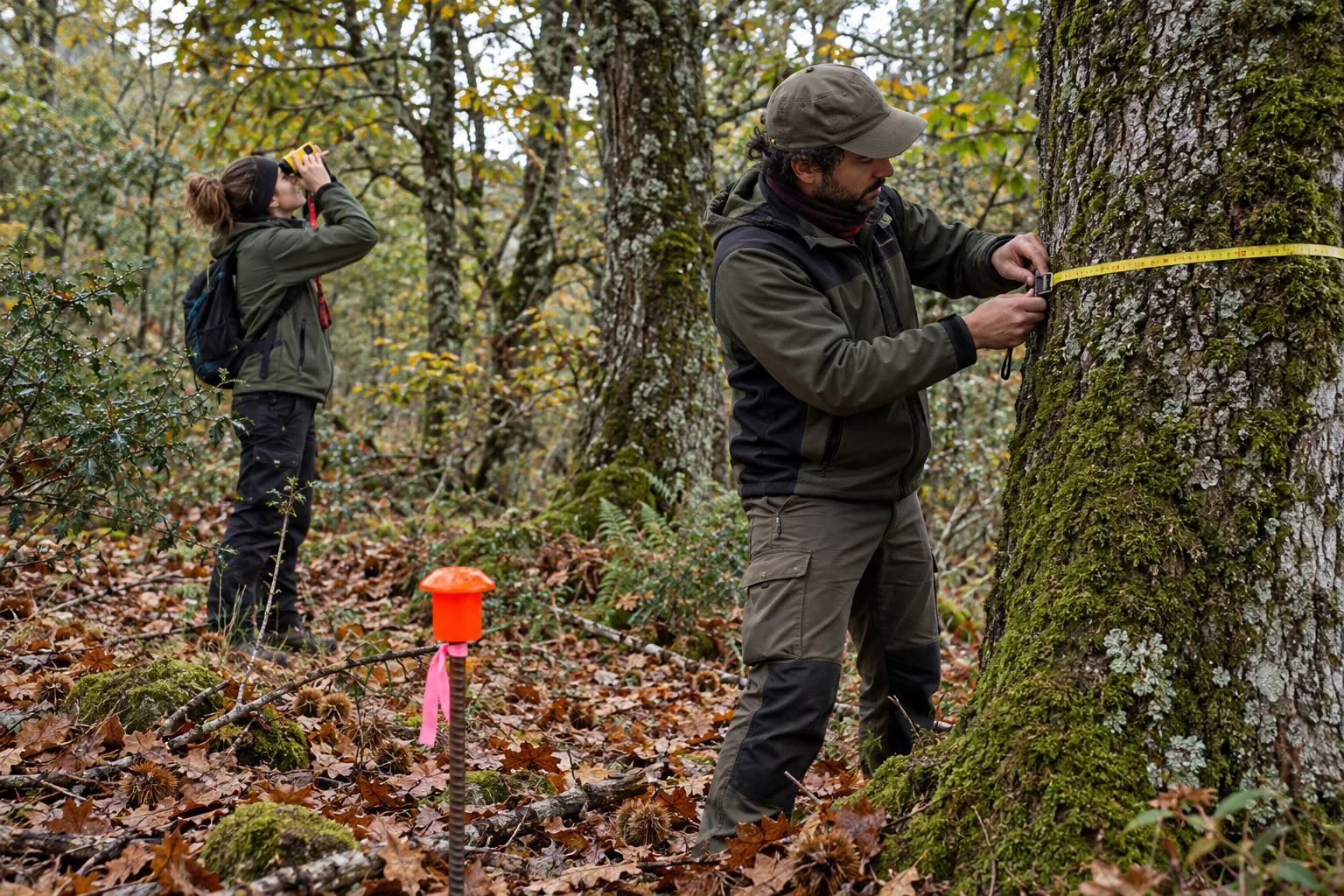
Two technicians measuring a forest inventory plot in an oak and chestnut wood

What we mean

An environmental result only counts if it can be measured and checked

Ecosystem services are the benefits a forest provides to the people who live in and around it: carbon fixed by vegetation and held in the soil, water regulation, biodiversity, soil that is not lost, and lower wildfire risk where the land is managed.

Work in a forest can improve those services, but to present it as a result you need to know the starting point (the baseline), measure the change with a recognised methodology, monitor it over time and have it checked by an independent party. Without that, there is no result to offer, only a good intention.

In SILVO+ we are working with NIGAL and ENCE on a methodology to quantify and verify the ecosystem services of silvopasture. And as managers of the FSC® and PEFC certification group «Propietarios das Mariñas» we know from the inside how forest management is audited.

What we will not claim

We will not talk about offsetting emissions, climate neutrality or specific impacts unless the project is backed by a methodology, verification and documents that support it.

Each sheet separates what has been measured and verified from what is a forecast, and sets out risks and limitations. If a figure does not exist yet, the sheet says «Not published».
Sponsorship, purchase or collaboration

Three ways to take part, and they are not the same

Sponsoring an action is not buying a credit, and technical collaboration is neither. Each sheet says clearly which type of involvement it offers; some may combine several.

Contribution or sponsorship

You support a specific action

What you provide
Money or resources so that the action can be carried out, in full or in part.
What you get
Progress reports and measured results, and the right to communicate your support on the agreed terms.
What you do not get
Any credit or environmental unit, or any right to deduct anything from your own emissions.
How it is communicated
«We support action X in forest Y», with the results that have been verified.

Purchase of a credit or unit

You acquire a result that has already been quantified

What you provide
The price of the units, on the terms stated in the sheet.
What you get
Ownership of specific units, calculated with a methodology and verified under the stated standard.
What you should check
Methodology, ownership, verification, registry, availability and conditions of use.
When it exists
Only for projects with the status «Units available».

Technical collaboration

You work with us on the project

What you provide
Knowledge, data, research, land, resources or funding under a cooperation agreement.
What you get
Whatever the agreement sets out: a say in the design, access to data, shared results.
What it is not
A sale of units or an advertising sponsorship.
Who it is for
Universities, technology centres, public bodies, companies and other local organisations.

Depending on who you are

What you will find here

Forest owners and communities

If you have a forest or a piece of work that could become an impact project.

  • How to propose it: through the interest form, telling us where the forest is, its approximate area and what you have in mind.
  • What we look at first: ownership and legal status of the land, management plan, possible actions and whether the result could be measured.
  • Process: preliminary assessment, site visit, baseline and proposed type of involvement. No project is published without the owners' agreement.
Propose a forest

Sponsoring companies

If you want to support projects with a territorial or environmental impact that can be checked.

  • Projects with the action, area and impacts described.
  • The sponsorship and collaboration options each one offers.
  • Indicators, monitoring frequency and progress reports.
  • What you can, and cannot, say about your support.
Register interest as a sponsor

Buyers of credits or units

If you want to acquire a quantified and verified environmental result.

  • Which unit or result is offered and the methodology used to calculate it.
  • Ownership of the units and verification standard.
  • Availability, timing and applicable terms.
  • Declared permanence, risks and limitations.
Register interest as a buyer

Partner organisations

If you want to cooperate on measurement, research, funding or local work.

  • Technical cooperation: inventory, mapping, monitoring.
  • Scientific cooperation: methodologies and validation.
  • Financial cooperation: calls for funding and funds.
  • Territorial cooperation: communities, municipalities and associations.
Propose a collaboration

Project portfolio

Available projects and projects in development

You will be able to filter them by area, type of impact, type of involvement, status and size. Each sheet is updated when new data, maps or reports are available.

We are preparing the first projects.

There are no projects in this portfolio yet. We will only add one once its baseline, methodology and verification system are defined and documented, and it states clearly what is on offer: sponsorship, funding, units or collaboration.

If you have a forest or a piece of work that could fit, or would like to hear when the first project is published, write to us.

How to read a project sheet

Nine sections, always the same

Every sheet follows the same structure so that projects can be compared. Anything that cannot be published yet is shown as such, not filled in with estimates.

  1. Identification

    Name, location, developer or owner, area and project status.

  2. Problem and action

    Starting point, planned action and link to the area.

  3. Impacts

    Carbon, biodiversity, water, wildfire prevention, soil or social impact, as relevant.

  4. Measurement

    Baseline, methodology, indicators, frequency, additionality and monitoring system.

  5. Safeguards

    Standard or framework used, validation or verification, permanence, risks and limitations.

  6. What is offered

    Sponsorship, funding, purchase of credits or units, collaboration or a combination, stating exactly what is on offer.

  7. Funding need

    Budget, amount already covered and amount outstanding, or commercial terms, where they can be published.

  8. Evidence

    Maps, photographs, reports, certificates, results and updates.

  9. Contact

    Form linked to the project and the person responsible for replying.

Project status

  1. Under studyWe are assessing whether the forest and the action can produce a measurable result.
  2. In developmentThe baseline, methodology and documents are being prepared.
  3. Open to fundingLooking for funding to be carried out.
  4. Available for sponsorshipAccepting sponsors for a defined action.
  5. Units availableHas verified credits or units for sale.
  6. FundedThe planned funding is in place.
  7. Under wayThe work is being carried out in the forest.
  8. Completed, under monitoringThe work is finished and measurements continue.

Measurement and safeguards

Terms you will see on the sheets

Baseline

The state of the forest before the action, and what would happen if nothing were done. It is the reference against which any improvement is measured.

Methodology

The written procedure for calculating a result: what is measured, with which instruments, which formulas and what margin of error. Each sheet states which one is used.

Additionality

The result is due to the project and would not happen anyway without it, for example because the law already requires it or because it was going to be done regardless.

Permanence

How long the result lasts and what happens if it is lost, for example through a wildfire or a change of land use. The sheets state the time horizon and the planned measures.

Validation and verification

Validation checks, before work starts, that the project design and methodology are sound. Verification checks afterwards that the reported results are real. Both are carried out by a party independent of the project developer.

Standard or framework

The set of rules used to design, measure and verify a project, which determines what can be offered and how it can be communicated. Each sheet states which one applies, or whether it is still to be decided.

Risks and limitations

What could go wrong and what the project does not guarantee. We publish them on the sheet itself so that sponsors, buyers and partners decide with full information.

Interest form

Tell us how you would like to take part

Fields marked * are required. We reply by email or phone, as you prefer. You can write in English, Spanish or Galician.

What are you interested in? *

Basic data protection information. Controller: Tenzas, Enxeñería e Asesoramento Legal, S.L. Purpose: to deal with your enquiry and reply to you. Legal basis: your consent. Recipients: no data are disclosed to third parties unless required by law. Rights: access, rectification, erasure and your other rights, by writing to pilar.orol@tenzas.es. Further information in the privacy policy.

Before you write

  • No commitment. Registering interest does not bind you to anything or reserve any units; it is a first contact.
  • We answer with data. If a figure has not been published yet for the project you are interested in, we will tell you so.
  • Owners first. No forest appears in this portfolio without the express agreement of its owners or community.

You can also call +34 982 809 154 or write to info@tenzas.es.

FSC and PEFC forest certification

Projects and innovation