Project · Silvopasture · Irixoa (A Coruña)
Raño Vivo: horses and goats to prevent wildfires on 342 hectares of community forest
Raño Vivo is the silvopastoral project of the Raño community-owned forest (monte vecinal en mano común), in the parish of Veríns (Irixoa, A Coruña). Tenzas drafted the technical report, the mapping and the monitoring plan: Galician purebred horses (cabalo de pura raza galega) and goats used as a forest management tool to reduce biomass, contain the acacia and coexist with the wolf. Submitted to the 2026 «Comprometidos con nuestros bosques» (Committed to our forests) call, promoted by Carrefour and coordinated by FSC Spain.
At a glance
Project summary
Submitted to the call- Location
- Raño community-owned forest, parish of Veríns (Irixoa, A Coruña): 342 ha, FSC® certified.
- Partners and organisations
- The Raño Community Forest Association (Comunidade de Montes Veciñais en Man Común de Raño), which owns and manages the forest. The call is promoted by Carrefour and coordinated by FSC Spain.
- Funding
- Submitted to the «Comprometidos con nuestros bosques» 2026 call (Block II, silvopastoral practices). No decision has been published yet.
- Timeline
- Technical report signed on 14-02-2026 · public presentation on 22-09-2026. Implementation dates: not yet set.
- Role of TENZAS
- Technical lead: technical and financial report, mapping, health and safety plan, management and indicator monitoring. Manager of the FSC® group the forest belongs to.
Where and why
A forest with too much biomass and very little livestock
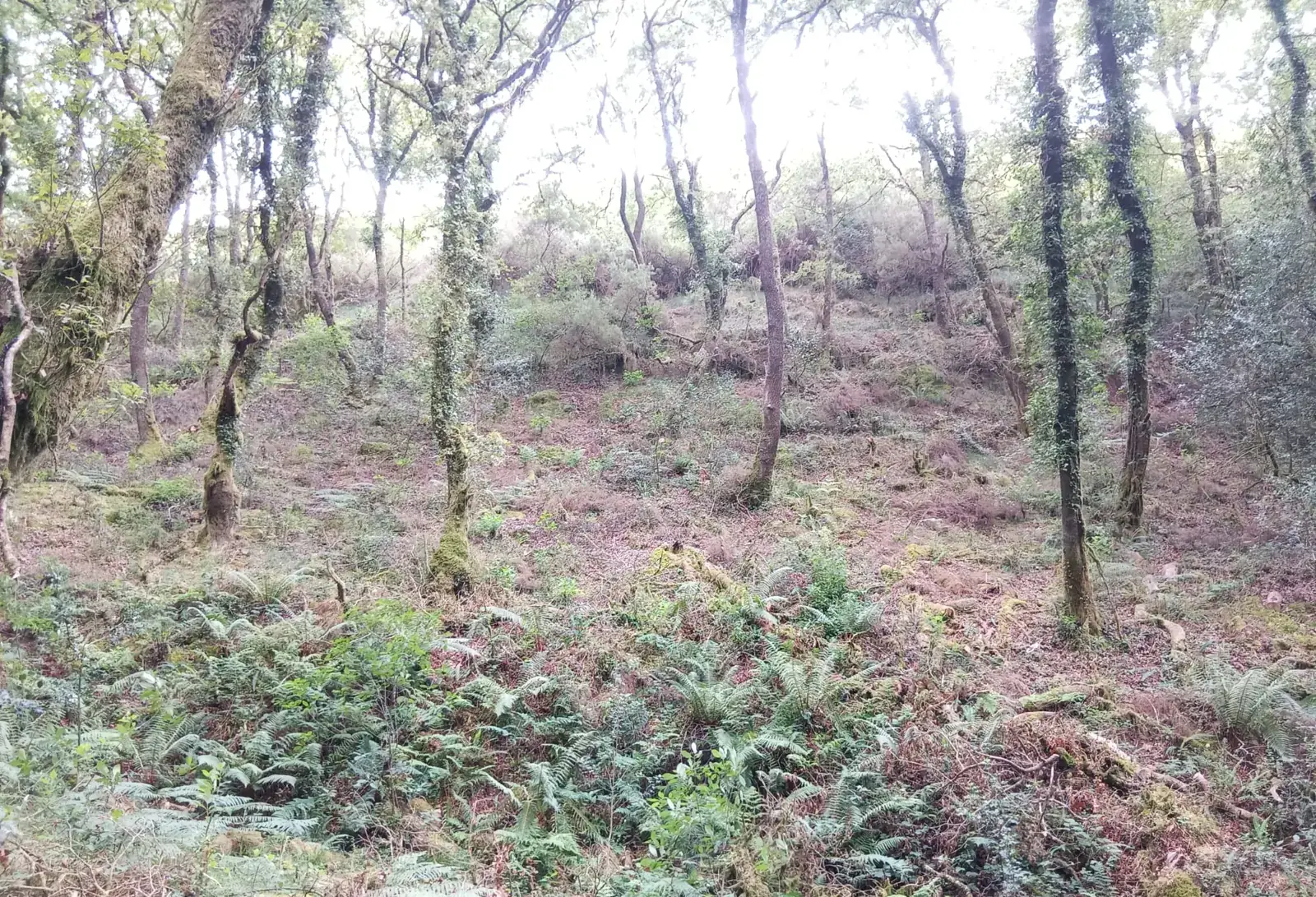
The Raño community forest covers some 342 hectares in the parish of Veríns, in the municipality (concello) of Irixoa (A Coruña). It combines areas of forest production, natural pastures and stands of native broadleaves, including 72 hectares of Galician-Portuguese oak woodland, a habitat of Community interest (HIC 9230). It is owned and managed by the Comunidade de Montes Veciñais en Man Común de Raño.
The land is ideal for extensive grazing, and especially for the Galician purebred horse. But for years livestock have not been able to stay on it, and the forest shows it:
- The natural meadows have filled with scrub for lack of grazing pressure.
- That accumulated biomass sharply increases the risk of fire.
- Traditional uses have gradually been abandoned and the forest barely produces anything.
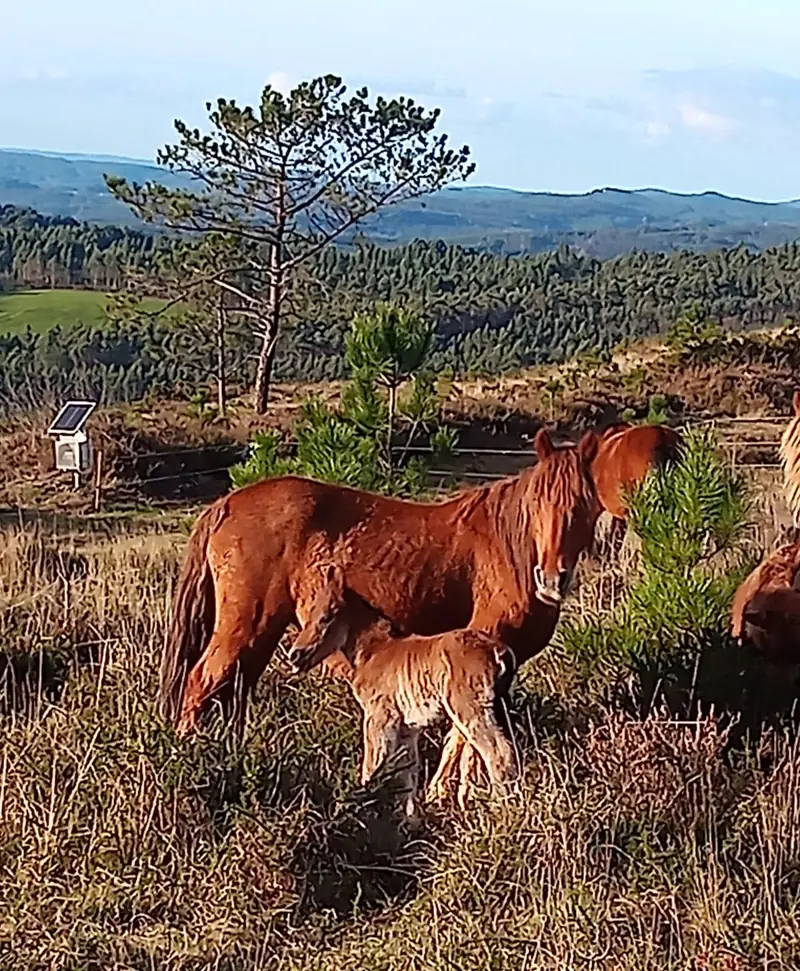
- Pressure from wolves makes it impossible to keep animals there on a stable basis, especially newborn foals.
Raño Vivo breaks that cycle: it brings livestock back to the forest, but with the infrastructure and technology needed so the wolf does not drive them out again.
What is being done
Five actions that support one another
All of them low-impact: no ploughing, no artificial sowing, no herbicides and no heavy machinery in sensitive areas.
1. Restoring 20 hectares of meadows
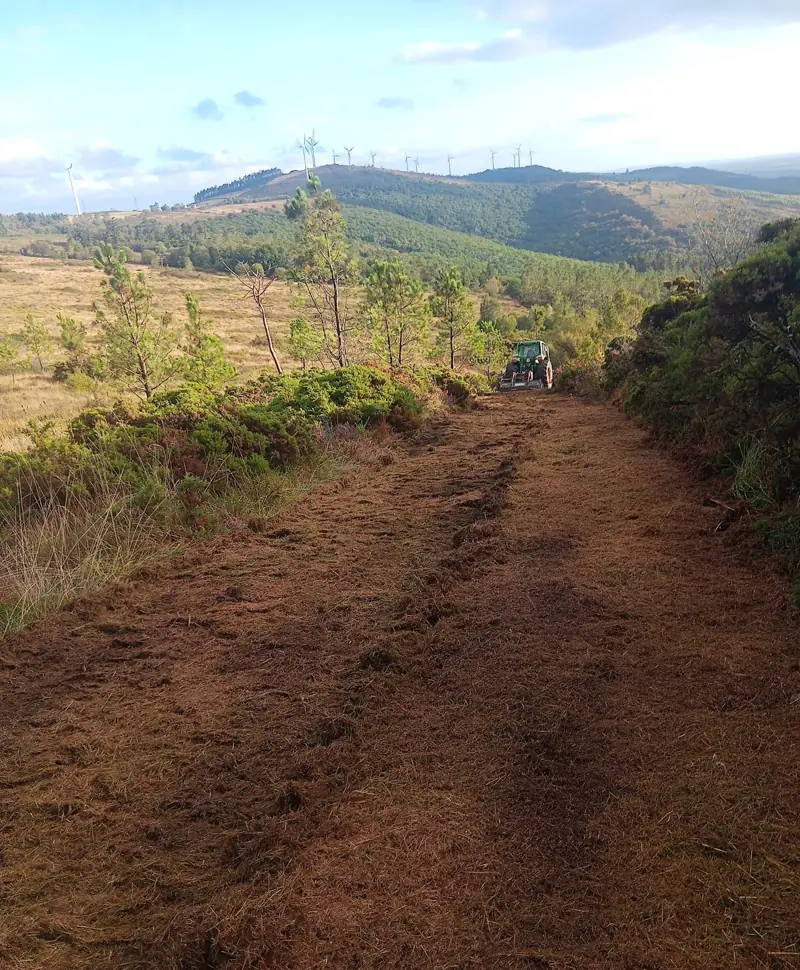
Mechanical scrub clearance and agricultural liming to correct soil acidity. With light and less acidic soil, the grassland seed bank starts working again on its own.
- More pasture, and of better quality.
- Less dry biomass, less risk of fire.
- Open areas that act as fuel breaks next to the broadleaf stands.
2. 1,210 metres of permanent wolf-proof fencing
Perimeter fencing around one of the meadows so that mares and foals can safely spend their first weeks of life in spring, when attacks are most frequent.
- Minimum effective height of 1.70 m.
- Tensioned stock or game mesh, wooden posts every 3-4 m.
- Electrified wires at the top and bottom, and a buried base.
3. Controlling acacia with goats
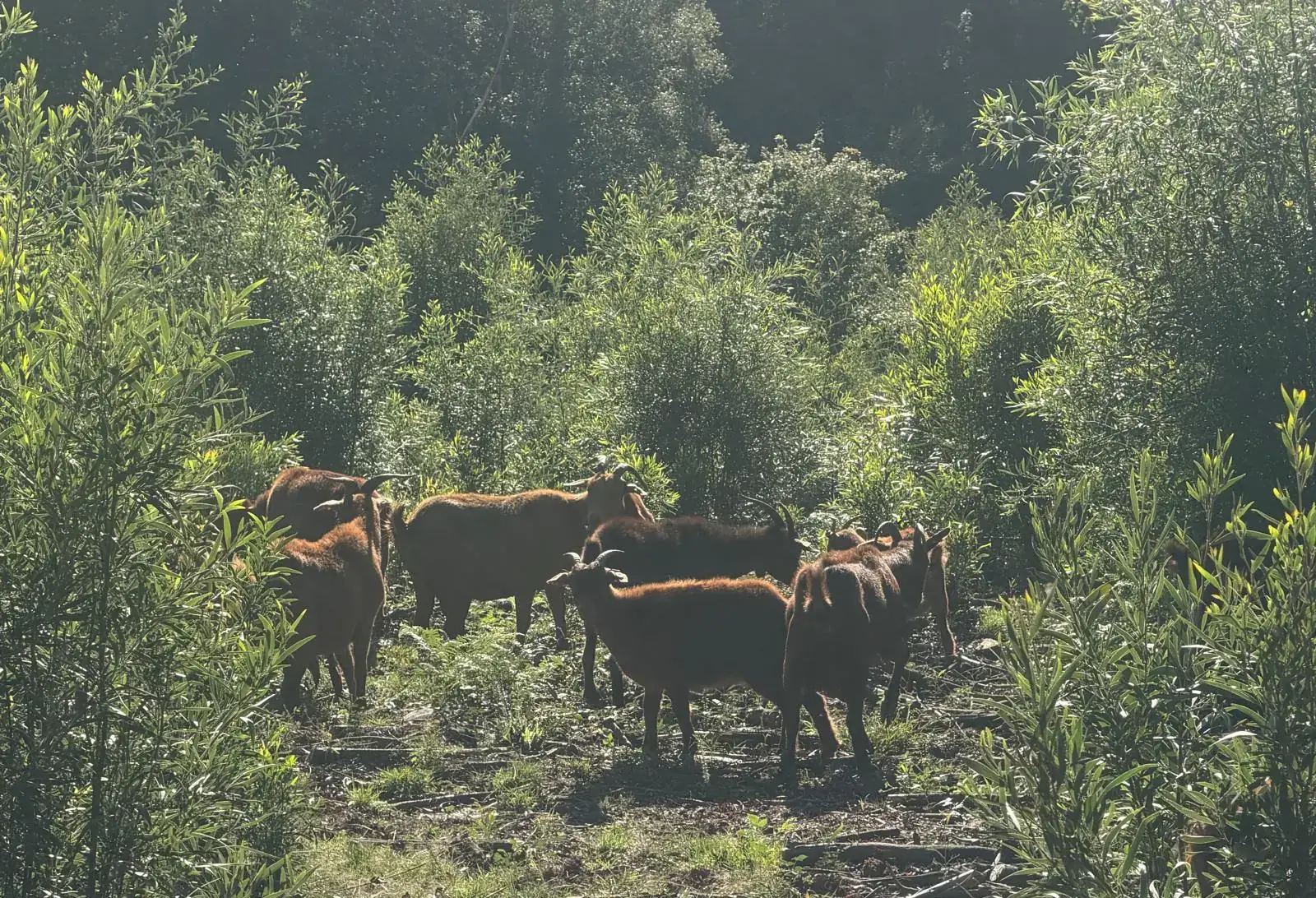
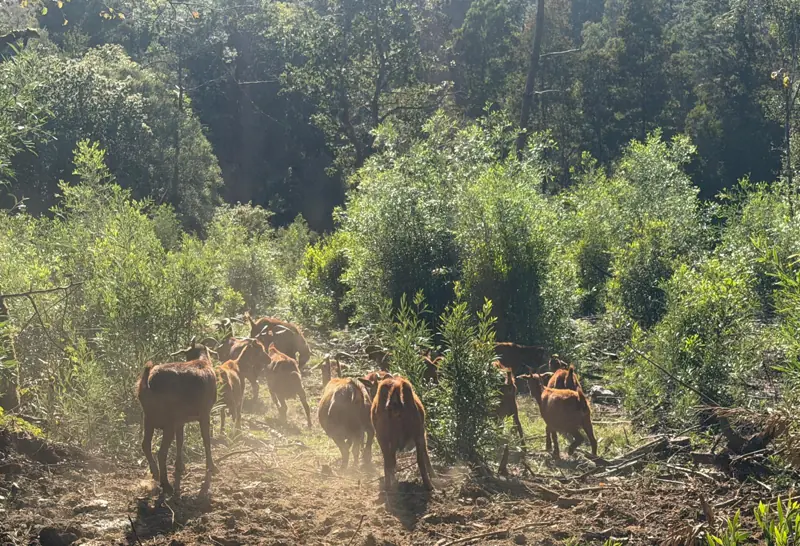
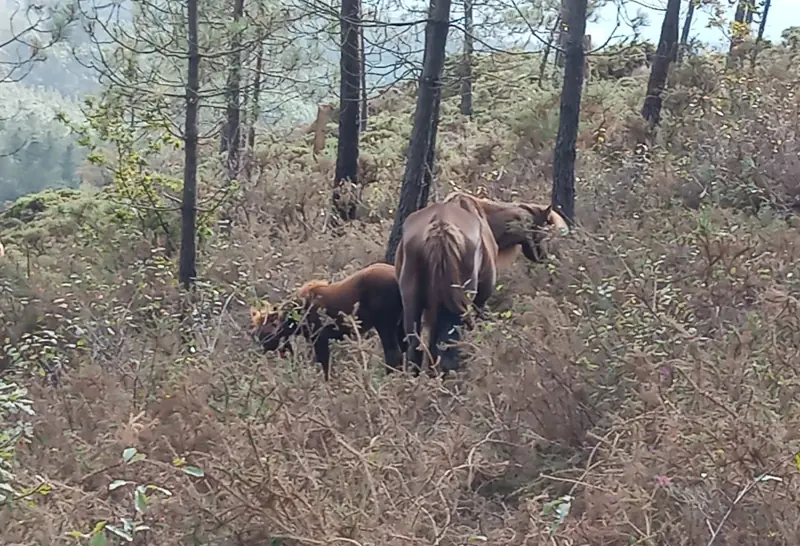
Blackwood acacia (Acacia melanoxylon) invades the understorey of the oak woods. A herd of 10 goats, kept in by 500 m of mobile electric fencing and moved on a rotational basis, eats the regrowth again and again until the plant is exhausted.
- Removal of scattered acacia and conifer trees within the broadleaf stand.
- Subsequent planting of native broadleaves.
- No herbicides or machinery on wet, sloping ground.
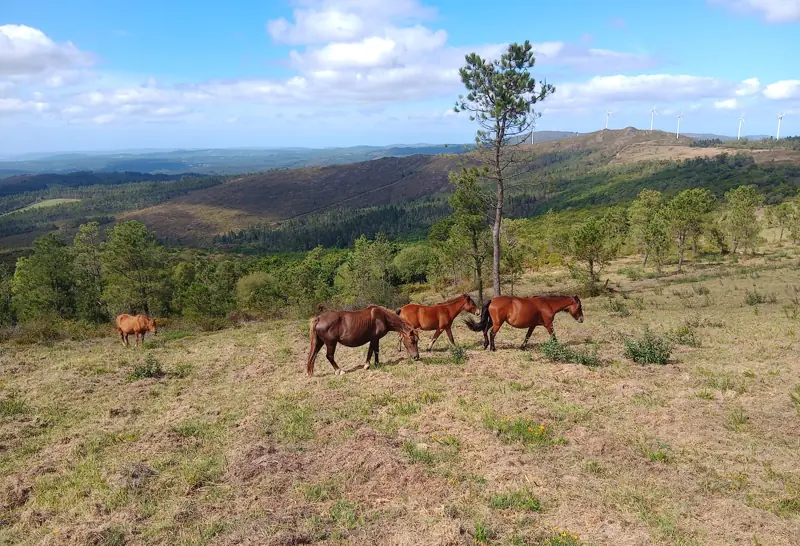
4. Ten Galician purebred horses
A native, hardy breed adapted to the Galician hills, which keeps the understorey under continuous control and reduces the cost of recurring mechanical clearance.
- Horses do not eat pine seedlings: compatible with plantations from the outset.
- Conservation of the breed's genetic heritage.
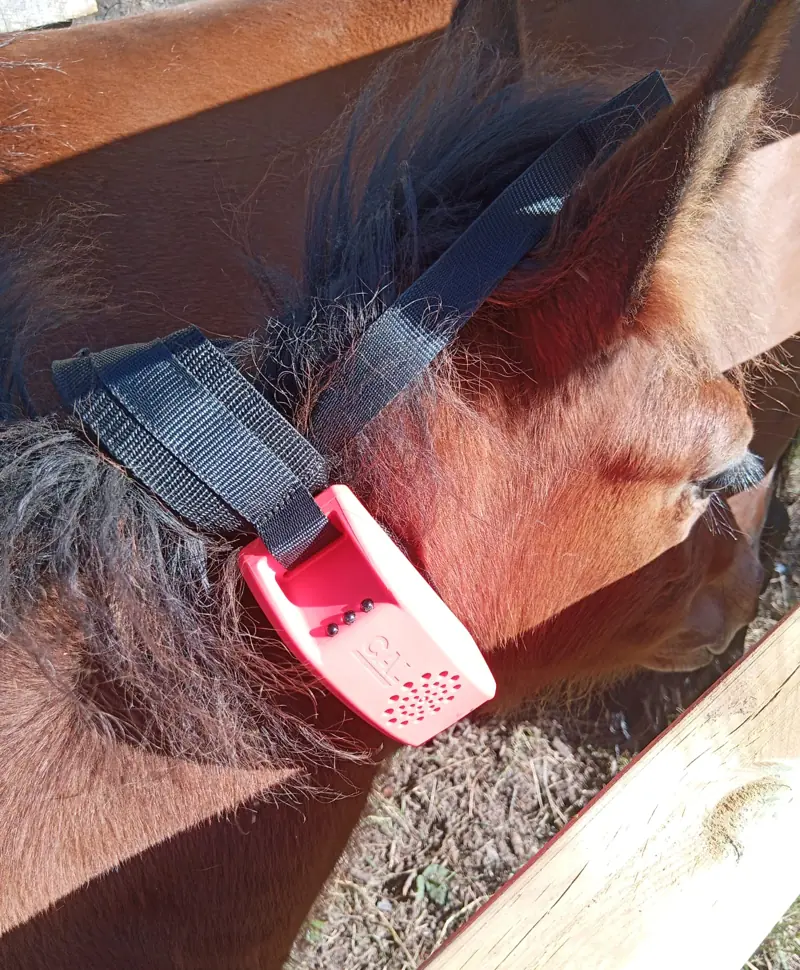
5. Deterrent GPS collars
Real-time geolocation and deterrence for the whole herd. They reduce predation without harming the wolf, and their data show where the livestock actually graze.
- Maps of actual use of the forest.
- Objective evidence of active management for FSC and the funder.
On the map
Where each measure takes place
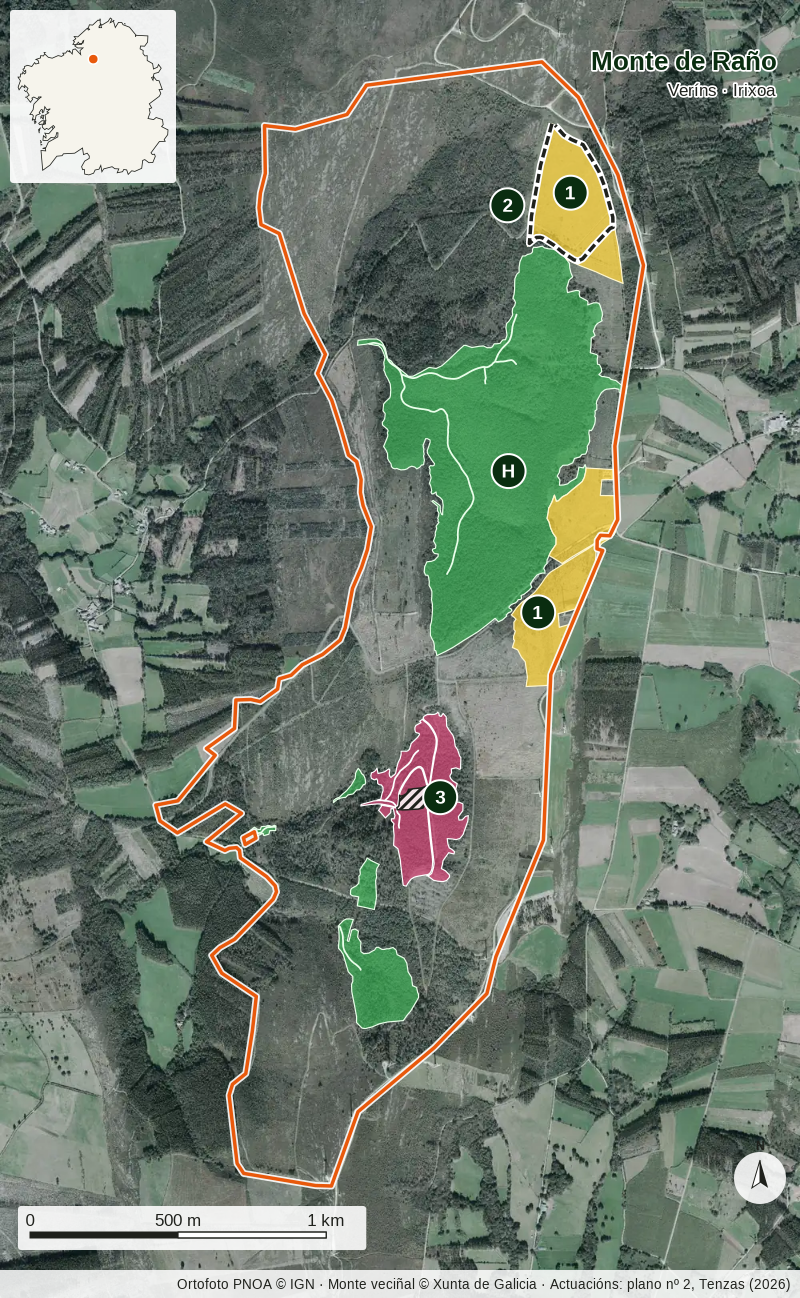
The Raño forest is a long, narrow strip, almost four kilometres from north to south, on the eastern edge of the municipality of Irixoa. The oak woods cover the centre and the north; the meadows to be restored lie at the northern tip and along the eastern edge, next to the forest track; the broadleaf stand with blackwood acacia is in the south-centre.
- Boundary of the Raño community forest in the Galician Government register (339.67 ha; the project works on 342 ha).
- Galician-Portuguese oak woods, habitat of Community interest 9230.
- Meadows to be restored (20 ha).
- 1,210 m permanent wolf-proof fence around the northern meadow.
- Broadleaf stand with scattered blackwood acacia and conifers (10.5 ha).
- Acacia regrowth patch where the goats will graze.
The horses and the GPS collars (measures 4 and 5) range across the whole forest.
Habitats, biodiversity and certification
A certified forest, with the baseline already measured
Raño is FSC®-certified within the «Propietarios das Mariñas» certification group (GFA-FM/COC-004755), managed by Tenzas. It also holds an approved and valid Ecosystem Services Certification Document (DCSE), with a verified impact on biodiversity conservation (SE1, impact SE1.3: maintenance of an ecologically sufficient network of conservation areas).
This means the project does not start from scratch: there is habitat mapping and FSC-validated biodiversity indicators against which to compare the before and after. The work moves from passive conservation to active management with measurable results.
The forest is also registered with CRAEGA (Consello Regulador da Agricultura Ecolóxica de Galicia, the Galician organic farming regulatory board), so grazing is carried out under organic production criteria.
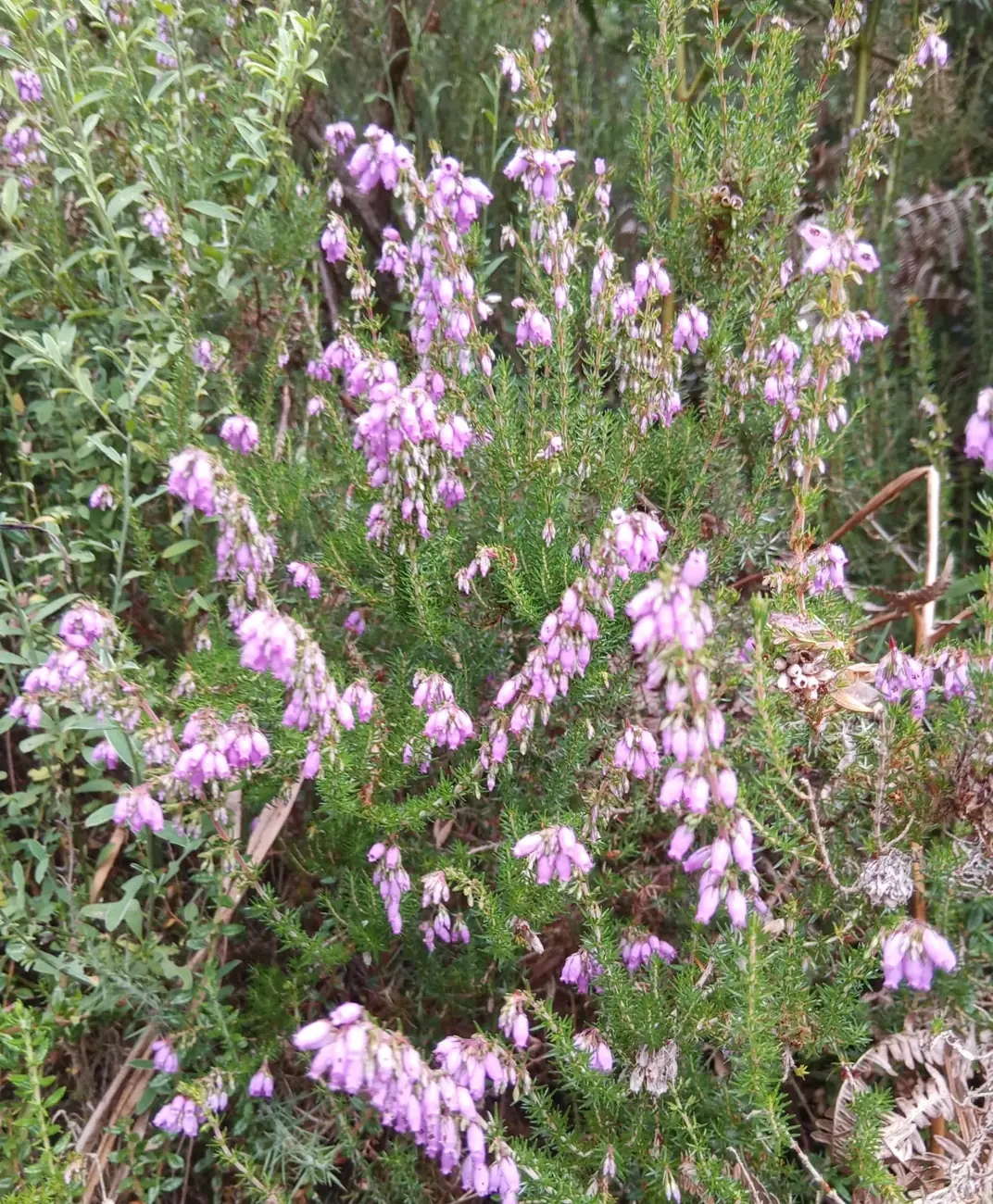
The key habitat is the 72 hectares of Galician-Portuguese oak woodland of Quercus robur and Quercus pyrenaica (HIC 9230). Acacia control and the removal of scattered conifers are concentrated in a stand of some 10 hectares where the invasive species competes with the natural regeneration of the oak.
The call
«Comprometidos con nuestros bosques» 2026
A programme promoted by Carrefour and coordinated by FSC Spain to fund the active management of certified forests. Raño Vivo is submitted under Block II, silvopastoral practices, and contributes to its objectives through biomass reduction, improved grasslands, landscapes more resilient to fire and measurable environmental, social and economic benefits.
FSC technical impact report
Actions, indicators and verified results, in a short document.
Dashboard
Area managed, biomass reduced, use of the forest by livestock, biodiversity, employment and community coordination.
Before-and-after mapping
Comparative maps of how silvopastoral use and fire risk evolve.
Livestock movement charts
Data from the GPS collars, as evidence that the forest is genuinely being managed.
What Tenzas has done
Technical drafting, mapping and project management
Tenzas holds the FSC® certificate of the group that Raño belongs to and is technically responsible for the project. The technical report was signed in Lugo on 14 February 2026 by José Manuel Yglesias Espiño, forestry engineer (ingeniero técnico forestal), registration no. 1,296 with the COETFG.
Technical and financial report
Assessment of the forest, objectives, description and justification of each action, fit with the programme and cost and impact analysis.
Mapping
Location map at 1:25,000 and works map at 1:10,000 on orthophoto, showing meadows, fencing, broadleaf stands and goat grazing areas.
Health and safety plan
For the clearance, fencing and livestock handling work.
Management and monitoring
Technical coordination, verification of indicators and dashboard, bringing together the DCSE, field data and livestock GPS data.
The Raño forest
On the ground
Status and monitoring
What is done and what is still to come
We describe each project as it stands: what has been done, what is still pending and what will be published once there is data.
Progress
Technical and financial report, 1:10,000 action map and health and safety plan, signed in Lugo.
Baseline available: the forest holds an approved and valid Ecosystem Services Certification Document (DCSE), with a verified biodiversity impact.
Public presentation of the project in Irixoa.
Results and materials
No results have been measured or published yet. When they are, they will appear here together with the data behind them.
Planned materials
- FSC® technical impact report.
- Indicator dashboard.
- Before-and-after mapping.
- Livestock movement charts from the GPS collar data.
Documents
There are no public documents for this project yet.
Related news
Also related
- Related projectSILVO+
- PeopleJosé Manuel Yglesias Espiño, Forestry engineer, signs the technical report
Public presentation on 22 September 2026
Raño Vivo was presented in Irixoa on 22 September 2026 as part of the «Comprometidos con nuestros bosques» call. Read the news item.
Contact
The model can be replicated in other community forests
If your forest community has too much scrub, wolves and a wish to bring livestock back, we can look at what would work and which call could fund it. Services for forest communities.
- C/ Miguel de Cervantes 51, mezzanine27003 Lugo (Galicia, Spain)
- 982 809 154Monday to Friday, during office hours
- info@tenzas.esEnquiries, quotations and certification stakeholders